
OVERVIEW
Why You Should Never Ignore a Burning Smell From Electrics
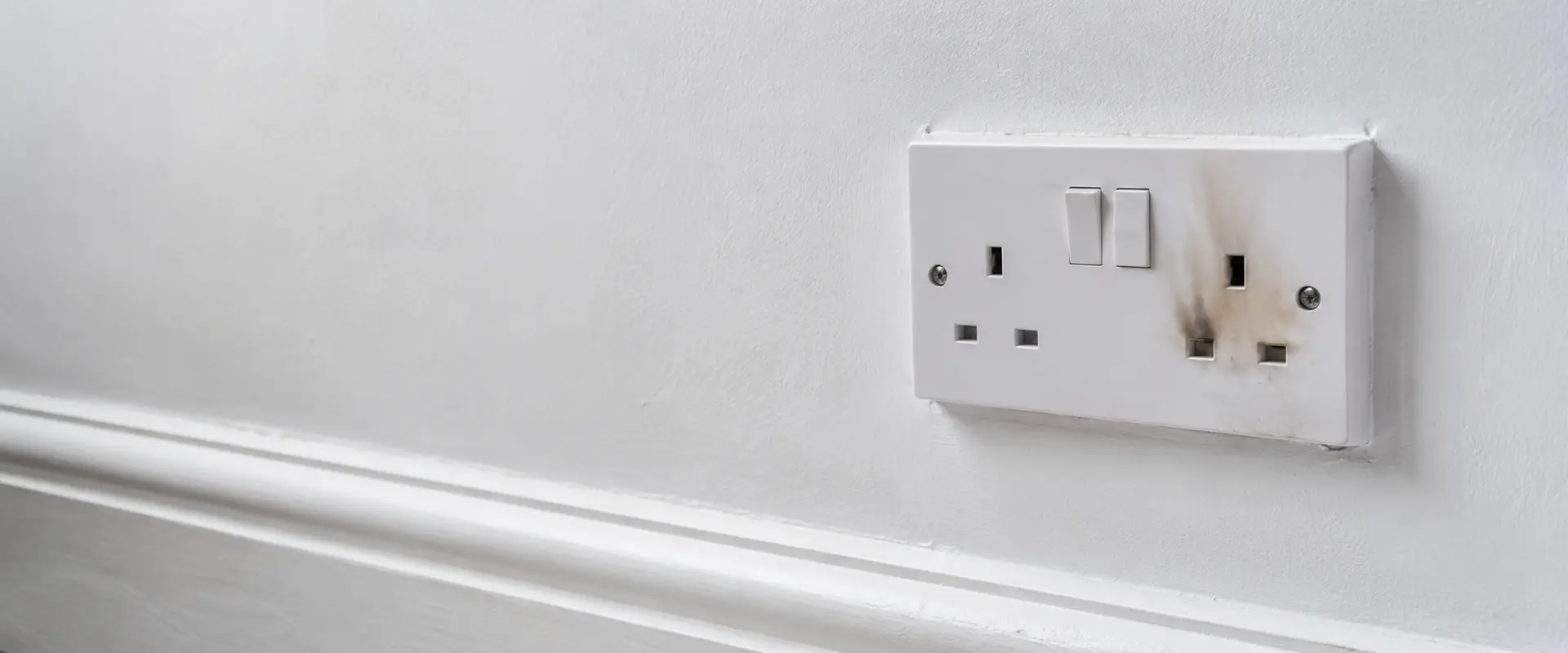
A burning smell from a socket, switch, fuse board or consumer unit in your home is one of the most serious warning signs your electrical installation can give you. Unlike a flickering light or a tripped RCD, a burning smell can indicate active arcing or overheating at a connection, both of which are leading causes of house fires in Ireland. ESB Networks data consistently shows that electrical faults are among the top causes of domestic fires reported to the fire service each year.
The smell itself can range from a faint warm plastic odour to a sharp acrid burning. It may come and go, and that intermittent nature is exactly what makes it dangerous: arcing at a loose connection does not always trigger your RCD. It can smoulder inside a back box or junction box for hours before producing visible smoke. Getting it checked immediately by a RECI-registered electrician is the only safe course of action.
CAUSES
What Causes a Burning Smell From Sockets and Electrics?
There are several distinct causes, and each one carries a different level of urgency. The most common cause in Irish homes is an overloaded socket or extension lead. Plugging too many appliances into a single outlet, or using an underpowered extension lead, creates sustained heat at the contacts. You may smell warm plastic before anything else fails visibly, but the damage to the socket is already happening.
A faulty appliance drawing excessive current is the second most common cause. A failing motor in a washing machine, a deteriorating heating element in a kettle, or a malfunctioning transformer in a charger can all pull more current than the circuit was designed for. In these cases, unplugging the appliance often removes the smell entirely. Even so, the socket should still be inspected: repeated overloading leaves scorch marks on the contacts and weakens the internal wiring connections.
In older Irish properties, two more serious causes become likely. Loose connections at a socket back box or junction box allow current to arc across the gap rather than flow cleanly through the wire. This arcing produces intense localised heat and a distinctive sharp burning smell. In homes built before the 1980s, aluminium wiring was sometimes used, and aluminium connections oxidise over time, dramatically increasing resistance and heat at every joint. If your home is over 40 years old and has never had a full rewire, a burning smell should be treated as a potential symptom of a systemic wiring problem, not just a single faulty socket.
Smell Something Burning? Do Not Wait.
A RECI-registered electrician can be with you today across all 26 counties.
IMMEDIATE STEPS
What to Do When You Smell Burning From Electrics
Switch off the circuit
If the smell is localised to one socket or switch, turn off that circuit at the consumer unit in your hall cupboard or utility room. Do not restore power until a RECI electrician has inspected and cleared the fault.
Smell from the consumer unit: main switch off
If the burning smell is coming from the consumer unit or fuse board itself, switch off the main isolator switch immediately. This is an emergency: call a RECI electrician right away. Do not attempt to open the consumer unit yourself.
Call 112 if there is smoke or flame
If you see any smoke, flames or discolouration around a socket or consumer unit, evacuate the property and call 112 immediately. Do not use water on an electrical fire. A CO2 or dry powder extinguisher only.
Unplug appliances on that circuit
Remove every appliance from the affected sockets. If the smell disappears immediately after unplugging one specific appliance, that appliance is likely the source. Set it aside and do not use it until it has been tested or replaced.
Document what you can see
Before you call an electrician, take a photo of the socket or fitting if it is discoloured or scorched. Note which circuit is affected and which appliances were in use. This helps the electrician assess the severity before arriving.
Do not restore power yourself
Even if the smell has faded, do not switch the circuit back on until it has been inspected. Arcing at a loose connection can smoulder inside a back box long after the visible signs disappear, and reignite when the load is reapplied.
PROFESSIONAL INSPECTION
What a RECI Electrician Will Check
When a RECI electrician arrives to investigate a burning smell, the inspection will typically begin at the point you reported the smell and work outwards. The first step is a visual inspection of the affected socket or fitting: they will remove the faceplate to check the back box for scorch marks, melted insulation, or discolouration on the live, neutral or earth terminals.
Where the cause is not immediately visible, a thermal imaging camera is an invaluable tool. It detects temperature differentials at connections without requiring every socket to be opened. A connection that is arcing or carrying excessive resistance will show as a hotspot on the camera even when it looks normal to the eye. This technology is now standard equipment for most competent electricians working on fault diagnosis in Ireland.
If the fault points to a broader wiring issue, the electrician may recommend an Electrical Installation Condition Report (EICR), also known in Ireland as a Periodic Inspection. This involves testing every circuit in the home against the IS 10101 standard to identify any further deterioration. An EICR is particularly important in homes over 25 years old or where a burning smell has been reported without an obvious single-point cause.
What the electrician will inspect
- Back box and faceplate of affected socket or switch
- All connections on that ring main or radial circuit
- Junction boxes in ceiling voids or under floors
- Consumer unit terminals and connections
- Thermal imaging scan of suspect areas
- RCD and MCB operation under load
- Earth continuity on the affected circuit
Safe Electric and certification
All electrical repair and inspection work carried out by a RECI-registered contractor is covered by Safe Electric, the scheme operated by the CRU (Commission for Regulation of Utilities). Any remedial work will be accompanied by a certificate of completion. You can verify any contractor instantly at safeelectric.ie.
COSTS IN IRELAND
What You Can Expect to Pay
The cost of dealing with a burning smell from electrics depends on whether it is treated as an emergency call-out and what the underlying fault turns out to be. Irish electricians typically charge an emergency call-out fee as a flat rate, on top of any materials and labour for the repair itself.
Dublin rates are consistently higher than the national average, particularly for out-of-hours work. Rural areas in the west, including Mayo, Donegal and Roscommon, tend to have the lowest rates, though travel time can add to the overall cost for very remote locations. Always confirm the call-out rate before the electrician arrives.
Note: prices are indicative for 2026. The call-out fee typically covers the first hour of labour. Additional work (socket replacement, rewiring a circuit, junction box repair) is charged at an hourly or fixed rate on top. Materials such as replacement sockets, cable and back boxes are charged separately.
FREQUENTLY ASKED QUESTIONS
Common Questions About Burning Smells From Electrics
Is a burning smell from a socket always an emergency?
Not always, but it should always be treated seriously. If the smell is faint and disappears the moment you unplug a specific appliance, the appliance is likely the cause rather than your wiring. However, even in this scenario you should still have the socket inspected: a damaged appliance can leave scorch marks on the contacts inside the socket that create a fire risk the next time a high-load device is plugged in. If the smell persists after removing all appliances, if it is strong, or if it comes from the consumer unit, treat it as an emergency and switch off the circuit or main switch immediately.
Can my RCD protect me from an arcing fault?
An RCD (residual current device) protects against earth leakage faults, which is not the same thing as arcing at a loose connection. Arcing between a live and neutral terminal at a back box will not necessarily cause a current imbalance large enough to trigger an RCD. This is why arcing faults are particularly dangerous and why a burning smell cannot be dismissed simply because your RCD has not tripped. Some newer consumer units installed to IS 10101 include AFDD (arc fault detection devices) which are specifically designed to detect arcing, but these are not yet standard in most Irish homes.
My house is old and the wiring has never been touched. Is it likely to be dangerous?
Older wiring is not automatically dangerous, but it does carry significantly higher risk of deterioration than modern PVC-insulated wiring installed to IS 10101. Rubber-insulated wiring used in Irish homes built before the 1970s becomes brittle over time, and the rubber can crack and crumble at connections. Aluminium wiring, used in some properties built during the 1960s and 1970s, develops oxidised connections that increase electrical resistance and heat. If your home has original wiring and you are noticing any burning smell, flickering lights, or repeated RCD tripping, a full Periodic Inspection by a RECI electrician is strongly advised. SEAI also offers grants for energy upgrades that in some cases cover rewiring work as part of a broader retrofit project.
How do I find a registered electrician quickly for an emergency?
The fastest way to verify and contact a registered electrician in Ireland is through electriciansinireland.ie, which lists RECI-registered contractors across all 26 counties. You can also search directly at safeelectric.ie, which is operated by the CRU. When calling an electrician for an emergency, describe the smell, its location in the home, and whether you have switched off the circuit. A reputable electrician will give you a clear indication of whether they can attend same day and will confirm the call-out rate before arriving. Always verify RECI registration before allowing work to begin.
Will my home insurance cover an electrical fault or fire?
Most Irish home insurance policies cover accidental fire damage, including fires caused by electrical faults. However, if an insurer can show that you were aware of a fault (a burning smell that was reported to someone or documented) and failed to act on it, they may challenge a claim. Having a RECI-certified inspection carried out and retaining the certificate of completion is important evidence that you took reasonable steps to maintain the installation. Some insurers also offer premium reductions for homes that have a valid Electrical Installation Condition Report on file. Check your policy schedule or contact your broker for specifics.
Get a RECI Electrician to Inspect Your Installation Today
All 26 counties. Verify registration instantly via Safe Electric before any work begins.
Find a registered electricianRELATED GUIDES