
What an RCD Does and Why It Trips
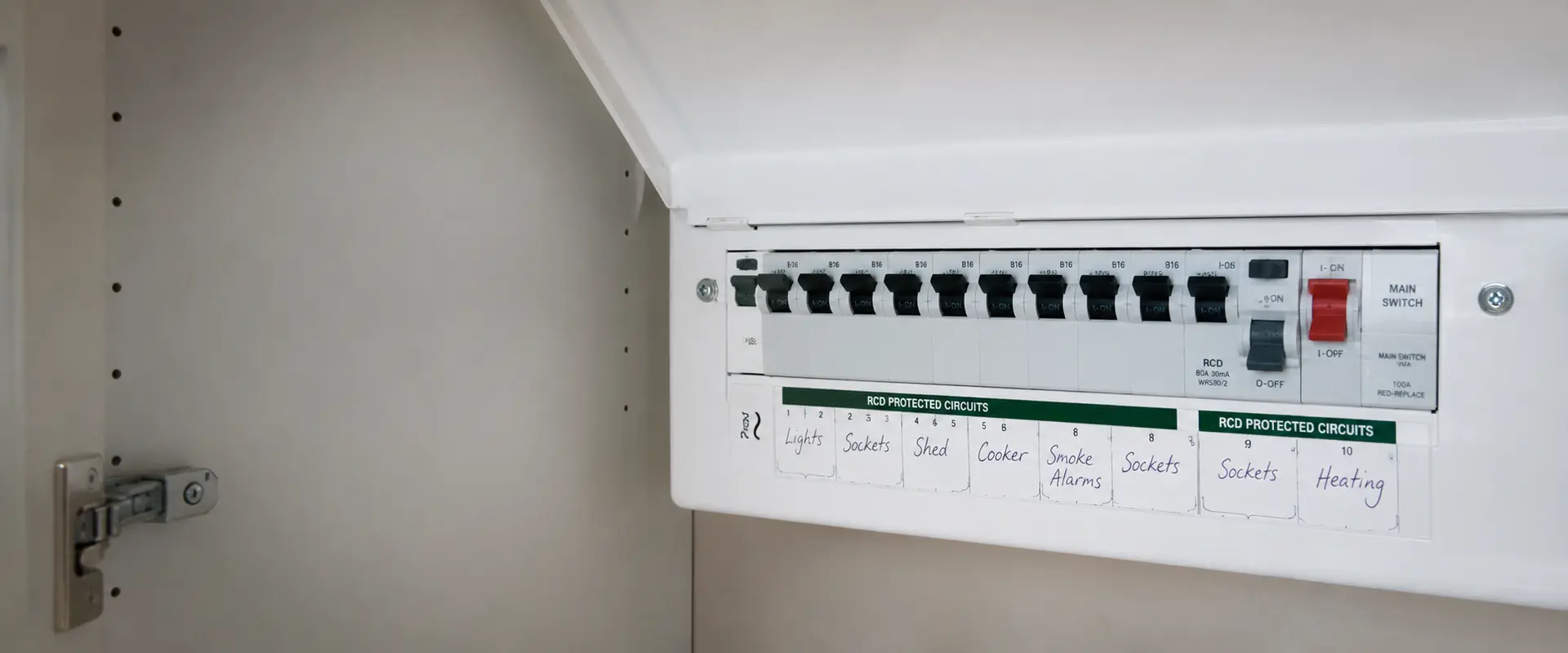
An RCD, or Residual Current Device, is a safety switch fitted in your consumer unit (the fuse board, usually located in a hall cupboard or utility room). It continuously monitors the current flowing out on the live conductor and returning on the neutral. If those two values differ by as little as 30 milliamps, the RCD detects a leakage to earth and shuts off power within 40 milliseconds. That speed is fast enough to prevent a lethal electric shock.
In Irish consumer units, one RCD typically protects a group of circuits rather than a single one. When it trips, all the circuits on that side of the board lose power simultaneously. The trip is always triggered by a genuine leakage: electricity is flowing somewhere it should not, whether through a faulty appliance, damaged wiring, or moisture in a socket. Understanding which cause applies in your home determines whether you can resolve it yourself or need a RECI-registered electrician.
Common Causes of RCD Tripping in Irish Homes
The vast majority of RCD trips in Irish homes come down to one of five causes. A faulty appliance is by far the most common, but damp, old wiring, and the wrong type of RCD for modern appliances all feature regularly in fault-finding call-outs.
Faulty appliance leaking to earth. This is the most common cause seen on RECI call-outs across Ireland. An appliance with a failing heating element, a degraded motor winding, or a damaged power cable can leak a small current to its metal casing. Because the casing is earthed, this leakage current returns via the earth conductor and the RCD detects the imbalance immediately. Washing machines, dishwashers, tumble dryers, and electric showers are the most frequent culprits.
Damp and water ingress. Outdoor sockets, garden lighting circuits, and sockets in utility rooms or garages are susceptible to moisture getting inside the back box or the socket face. Water is conductive, so even a film of condensation on internal components can create a leakage path to earth. Trips that happen specifically after rain, or that clear when the weather dries out, almost always point to moisture ingress somewhere on the circuit.
Deteriorating cable insulation. Older Irish homes built before the 1980s often retain original rubber-insulated or fabric-insulated cables in parts of the installation. Rubber insulation dries out over decades, becomes brittle, and cracks. Once the insulation breaks down, the bare copper conductor can touch an earthed surface inside a wall or floor, creating a continuous leakage. If the RCD trips even with all appliances disconnected, deteriorating fixed wiring is the most likely explanation.
If your RCD keeps tripping and you cannot identify a faulty appliance, it often points to a failing circuit. A fuseboard upgrade may be needed to bring the installation up to current standards, or a periodic inspection will identify the exact fault in the fixed wiring.
Intermittent RCD Tripping: No Obvious Cause
A RECI-registered electrician can test each circuit with an insulation resistance meter to locate the exact leakage in minutes. Find one in your county today.
Find an electrician in your countyLess Obvious Causes Worth Knowing About
Beyond the obvious faults, there are causes specific to modern Irish electrical installations that are becoming more common as homes add EV chargers, inverter appliances, and LED lighting systems.
Nuisance tripping from Type AC RCDs
Standard Type AC RCDs, still found in many Irish consumer units, are designed to detect pure sine-wave leakage currents. Modern appliances with switch-mode power supplies, EV chargers, inverter washing machines, and LED drivers can produce pulsating DC leakage that a Type AC RCD misreads and trips on. Under IS 10101 (the Irish Wiring Rules), a Type A RCD is required for circuits supplying these appliances. If your RCD trips intermittently with no obvious fault, the RCD type may be the issue.
EV charger installation
EV chargers require a dedicated circuit and, under current Irish regulations, must be protected by a Type A RCD at minimum. A standard Type AC RCD on an EV charger circuit will often cause nuisance trips, particularly during the initial charging ramp-up. If your RCD started tripping after an EV charger was installed, the protection device type needs to be reviewed by a RECI electrician.
The RCD itself has failed
RCDs are electromechanical devices with a finite service life. The test button mechanism can degrade, internal contacts can corrode, and the sensing coil can drift out of calibration. An RCD that trips immediately on reset, or that trips with nothing on the circuit at all, may itself be the fault. Pressing the test button monthly keeps the mechanism exercised; if the test button no longer trips the device, the RCD needs replacement.
Recent DIY or electrical work
An RCD that starts tripping after a new light fitting, socket, or appliance was connected is almost always caused by that new connection. Reversed polarity, a nicked cable during installation, or a loose wire touching an earth terminal are common results of DIY electrical work. Under Irish law, most fixed electrical work in a home must be notifiable to your local building authority and carried out or certified by a RECI contractor.
How to Find the Fault Yourself
This step-by-step process lets you narrow down whether the fault is in an appliance or in the fixed wiring, without any specialist equipment. Work carefully and do not attempt to open consumer units or work on fixed wiring yourself.
- 1
Isolate all circuits under the tripped RCD
Open your consumer unit and locate the tripped RCD (it will be in the middle position or switched to off). Before resetting it, switch off every individual circuit breaker on the RCD's side of the board. You are not isolating the whole house, just the circuits that the tripped RCD protects.
- 2
Reset the RCD
With all circuit breakers switched off on that side, push the RCD back to the on position. If the RCD will not stay on even with all breakers off, the RCD itself may be faulty or there is a fault on the supply side. Stop here and call a RECI electrician.
- 3
Re-energise circuits one at a time
Switch each circuit breaker back on one at a time, pausing a few seconds between each one. When the RCD trips, the circuit you just switched on contains the fault. Switch that breaker back off, reset the RCD, and continue to confirm all other circuits are healthy.
- 4
Disconnect all appliances on the faulty circuit
Go to every socket and outlet on the faulty circuit and unplug every appliance. Switch off and unplug at the socket. Then switch the circuit breaker back on. If the RCD holds, the fault is in an appliance, not the wiring.
- 5
Reconnect appliances one by one
Plug appliances back in one at a time, switching on each one before moving to the next. The appliance that causes the RCD to trip is the faulty one. Remove it from service and have it inspected or replaced. Do not plug it back in.
- 6
RCD still trips with all appliances off
If the RCD trips on a circuit even with every appliance disconnected, the fault is in the fixed wiring, not an appliance. This requires an insulation resistance test by a RECI electrician. Do not continue using that circuit until it has been tested and cleared.
When to Call a RECI Electrician
The diagnostic steps above can identify whether the fault is in an appliance or in the fixed wiring. Once you have established it is in the fixed wiring, or if you cannot identify the cause at all, the job requires a professional with an insulation resistance meter. A RECI-registered electrician will test each circuit individually to locate the exact point of leakage, whether that is a damaged cable under a floor, a corroded junction box in a wall, or degraded insulation in a spur.
A typical fault-finding visit in most Irish counties costs €80 to €200 for the call-out and diagnosis. Dublin rates are generally at the higher end of that range. Rural counties in the west, including Mayo, Donegal, and Roscommon, typically see lower rates. If a replacement RCD is needed, parts and labour will add €80 to €200 on top of the diagnostic fee.
RCD will not stay on
If the RCD trips immediately on reset even with all circuit breakers switched off, there is either a fault on the supply side or the RCD itself has failed. Do not continue resetting it. Call a RECI electrician.
Fault is in fixed wiring
If the RCD trips on a circuit with all appliances disconnected, the cable insulation has failed somewhere. This needs an insulation resistance meter to locate. Not a DIY repair.
RCD tripping after rain
Moisture ingress at outdoor sockets or garden lighting requires a qualified electrician to locate, dry out, and refit to IP-rated standard. Outdoor electrical work must meet IS 10101 requirements for external installations.
Nuisance tripping on EV circuit
If your EV charger is on a circuit with a Type AC RCD, it may need to be upgraded to Type A. This is a notifiable works item and must be carried out by a RECI-registered contractor.
RCD Tripping: Common Questions
Find a RECI-Registered Electrician
Only a RECI-registered electrical contractor can carry out insulation resistance testing, replace RCDs, and certify the work under IS 10101. Find one in your county today.
Find an electrician in your county