
OVERVIEW
The Law Behind Notifiable Works in Ireland
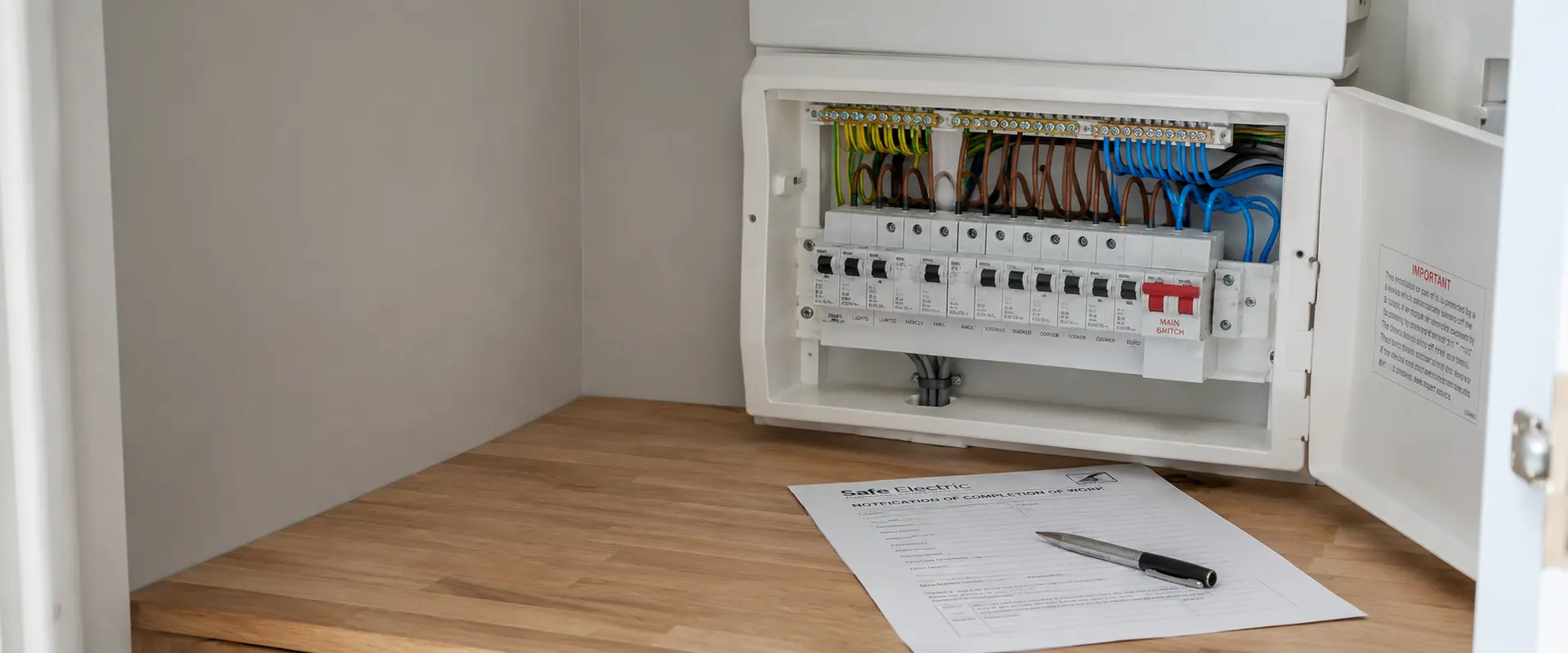
Under the Electricity Supply (Safety and Welfare) Act 1999 and Statutory Instrument 73 of 2000, a defined category of electrical work in Ireland is classified as notifiable. This means the work must be carried out by a RECI-registered electrical contractor, who is then legally required to notify Safe Electric and issue a Notification of Completion of Work certificate to the homeowner or building owner on completion. The legislation exists to protect lives and property: faulty electrical installations are a leading cause of house fires in Ireland, and the notification system provides an auditable record that work meets Irish Wiring Rules (IS 10101).
The system is overseen by the Commission for Regulation of Utilities (CRU), with Safe Electric as the scheme operator. RECI contractors are the only trade category authorised to carry out and certify notifiable works. Understanding which category your planned work falls into is essential before you hire anyone or spend money on materials.
1999
Act establishing notifiable works framework in Ireland
SI 73
Statutory instrument defining the notifiable works categories
2,000+
RECI-registered contractors across all 26 counties
IS 10101
Irish Wiring Rules standard all notifiable work must comply with
NOTIFIABLE WORKS
What Counts as Notifiable Electrical Work?
The notifiable works categories are broader than most homeowners expect. Any installation of new fixed wiring falls under the rules: this covers adding a new circuit to an existing consumer unit (fuse board), installing a new consumer unit entirely, or carrying out a full rewire of a property. New fixed wiring means the work is permanently embedded in or attached to the fabric of the building, as distinct from plugging in an appliance.
Location also triggers notifiable status. Any electrical equipment connected to fixed wiring in certain zones must be notified regardless of the type of equipment. The relevant zones under IS 10101 include kitchens (within certain distances of sinks and water sources), bathrooms and shower rooms (zones defined by proximity to water), outdoor locations including gardens, outbuildings and garages, and swimming pools or water features. A socket outlet installed in a garage, or a shaver socket in a bathroom, both require notification.
New technology installations are explicitly notifiable. EV charger installations, solar PV connections to the grid or battery, heat pump electrical connections, and any work on new builds all fall under the notifiable category. These are among the fastest-growing categories of notifiable work in Ireland as SEAI grant-funded retrofits increase in volume. ESB Networks also requires notification when a new generation source such as solar PV is connected to the mains supply.
Need a RECI Contractor Near You?
Every electrician listed on electriciansinireland.ie is RECI-registered and authorised to certify notifiable works.
EXAMPLES BY CATEGORY
Six Notifiable Works Categories in Plain English
01
New fixed wiring
Adding a new circuit, installing a new fuse board, or carrying out a full rewire. All require a RECI contractor and completion certificate.
02
Kitchen and bathroom zones
Any fixed electrical equipment installed within the defined zones around sinks, cookers, baths or showers is notifiable regardless of the job size.
03
Outdoor and outbuildings
Garden sockets, shed wiring, garage circuits, exterior lighting on its own circuit: all notifiable. Exposure to weather is the key risk factor here.
04
EV charger installation
Every home EV charger installation is notifiable. The SEAI EV grant also requires a RECI certificate before the grant can be processed and paid out.
05
Solar PV and heat pumps
Connecting solar panels or a heat pump to your electrical system requires notification to both Safe Electric and ESB Networks for grid-connected systems.
06
New builds
All electrical work on a new build is notifiable. A completion certificate is a requirement for ESB Networks to energise the meter and connect the property to the grid.
NON-NOTIFIABLE WORKS
What Does Not Need Notification?
Not every electrical job is notifiable. A competent person, which in practice means someone with basic electrical knowledge rather than a qualified contractor, can carry out certain minor works without the need for a RECI contractor or a completion certificate. The core principle is like-for-like replacement of fittings that do not involve fixed wiring.
Common examples of non-notifiable work include replacing a socket faceplate with an identical type (same position, same circuit, no new wiring), swapping out a light fitting for another fitting of the same type on an existing ceiling rose, and replacing a like-for-like appliance where the connection is via a plug or a pre-existing connection point. Decorating and painting, even around electrical fittings, is obviously not notifiable.
Notifiable: requires RECI cert
- New circuit added to fuse board
- New fuse board installation
- Full or partial rewire
- Any socket or fitting in kitchen zone
- Any socket or fitting in bathroom zone
- Outdoor wiring: garden, shed, garage
- EV charger installation
- Solar PV electrical connection
- Heat pump electrical connection
- All new build electrical work
Non-notifiable: no cert required
- Replacing a socket faceplate like-for-like
- Swapping a light fitting on existing rose
- Replacing a plug-in appliance
- Painting and decorating near fittings
- Replacing a doorbell battery
- Replacing fuses in a consumer unit
- Testing a smoke alarm
CONSEQUENCES
What Happens If Notifiable Work Goes Uncertified?
Skipping the notification process does not just mean a paperwork problem. Uncertified notifiable work is legally unverified work. The practical consequences can be severe and tend to surface at the worst possible moments: when you are selling the property, re-mortgaging, making an insurance claim, or applying for an SEAI grant.
On the insurance side, home insurance policies in Ireland typically contain a clause requiring that all electrical work meets statutory requirements. If a fire or electrical incident occurs and it can be linked to uncertified notifiable work, your insurer has grounds to deny the claim. You may find out about this exclusion only when you need the policy most.
On the property transaction side, solicitors acting on a house sale will request completion certificates for any notifiable works carried out during the period of ownership. Buyers' solicitors routinely raise this as a requisition on title. Missing certificates can delay or block a sale entirely. Lenders also require certification when re-mortgaging: if you have had a rewire or EV charger installed without certification, a new lender may refuse to proceed until the position is regularised.
Retrospective certification is possible but it is expensive and not guaranteed. The process requires a RECI contractor to carry out an Electrical Installation Condition Report (ECIR), which involves inspection and testing of the affected installation. If the work is found to be non-compliant with IS 10101, it must be remediated before any certificate can be issued. Depending on the scale of remediation required, the total cost of retrospective certification can significantly exceed what the original certified installation would have cost.
COMMON QUESTIONS
Notifiable Works: Frequently Asked Questions
Can I do notifiable work myself and then have it inspected?
No. Under SI 73 of 2000, notifiable work must be carried out by a RECI-registered electrical contractor. It is not sufficient for a homeowner or unregistered tradesperson to do the work and then have a RECI contractor inspect it afterwards. The RECI contractor must carry out the work from the outset. A RECI contractor will not certify work they did not carry out, and doing so would expose them to regulatory sanction.
Is adding a single socket in my kitchen notifiable?
Yes, in most cases. If the new socket requires extending an existing circuit or adding a new circuit, it involves new fixed wiring and is notifiable. If it is located within the kitchen zone as defined by IS 10101 (typically within 300mm of a sink), it is notifiable for that reason alone even if the wiring work is minimal. The only scenario where a kitchen socket might not be notifiable is a like-for-like replacement of an existing socket in the same position, but even then it is best to confirm with a RECI contractor before proceeding.
How do I verify the contractor I hired was actually RECI-registered?
You can verify any contractor's registration directly on the Safe Electric website using their name or registration number. You can also use the search tool on electriciansinireland.ie. Every listed contractor here is RECI-registered and in good standing. Always ask for the contractor's RECI number before work begins, and verify it yourself rather than taking it on trust. A genuine RECI contractor will have no objection to this.
What does the completion certificate actually cover?
The Notification of Completion of Work is the RECI contractor's declaration that the works they carried out comply with IS 10101 (Irish Wiring Rules) and all applicable Irish electrical safety regulations. It includes the contractor's RECI number, the address, a description of the works, the test results, and the date. It is the document you present to your insurer, your solicitor, or your lender as proof that the electrical installation is safe and legally compliant. Keep all completion certificates for your property in a safe place for as long as you own it.
Does a SEAI grant require a notifiable works certificate?
Yes. The SEAI Better Energy Homes scheme and the One Stop Shop retrofit programme both require that all electrical work carried out as part of the grant-funded installation is completed by a RECI-registered contractor and a completion certificate issued. For EV charger grants specifically, the completion certificate is a required document in the grant claim process. If you proceed with a non-registered installer to save money upfront, you will not be able to claim the grant and may face issues with your home insurance as well.
Find a RECI Contractor for Notifiable Works
Every electrician listed on electriciansinireland.ie is RECI-registered, authorised to carry out notifiable works, and able to issue you a valid completion certificate.
Find an electrician near youRELATED GUIDES