
Outdoor Electrical Work in Irish Homes
Outdoor electrical installations are among the most popular electrical additions Irish homeowners make. A weatherproof socket on the back wall, a run of garden lighting, a supply to a shed or garage, or a security light above the front door all fall into this category. Each involves running new circuits from the consumer unit, and all of them are classified as notifiable work under Irish electrical regulations.
Notifiable work means the job must be carried out by a RECI-registered electrical contractor who is authorised to self-certify the installation. On completion they issue a completion certificate confirming the work complies with IS 10101, the Irish Wiring Rules. Without that certificate, the work is unverified and may affect your home insurance cover or your ability to sell the property.
Technical Requirements for Outdoor Wiring
Outdoor wiring is held to a higher technical standard than indoor circuits because of the exposure to rain, frost, physical impact, and in the case of underground cables, vehicle loading and excavation risk. IS 10101 sets out the specific requirements that apply in Ireland, and a registered electrician must design and install the circuit to comply with those rules.
All outdoor sockets must be RCD protected. In practice this means either an RCD in the consumer unit covering the outdoor circuit, or a combined RCD socket at the point of use. The minimum IP rating for sockets in exposed locations is IP65, which means dust-tight and protected against water jets. Sockets in more sheltered positions such as a covered porch can sometimes use IP44, but your electrician will confirm which rating is appropriate for each location.
For cables buried underground, IS 10101 requires either steel wire armoured (SWA) cable or standard cable in rigid conduit. Burial depth must be at least 500mm below finished ground level in open ground, and 750mm under paths and driveways. These depths are the minimum: going deeper is always acceptable and reduces the risk of damage from garden tools or construction work. Surface-mounted conduit on exterior walls is also used where trenching is not practical.
Ready to Add Outdoor Power?
Find a RECI-registered electrician in your county. Every contractor listed is verified on the Safe Electric register and can certify outdoor electrical work.
Find an electrician in your countyWhat Affects the Cost of Outdoor Electrics?
The gap between the cheapest and most expensive outdoor electrical jobs is wide. These are the factors that move the price most significantly.
Distance from the consumer unit
A socket fitted on the back wall of a semi-detached with the consumer unit in the hall cupboard a few metres away is a short run. A shed at the end of a 30-metre garden needs much more cable, more conduit or SWA armoured cable, and more labour time for the trench.
Trenching and reinstatement
Digging a trench through a lawn and backfilling it is straightforward. Cutting through a paved patio, lifting setts or flags, and reinstating them to match is significantly more expensive. Concrete driveways are the most costly to cut and reinstate.
Number of circuits and points
A single outdoor socket is one circuit and one outlet. A full garden lighting scheme with multiple zones, a dedicated socket for garden tools, and a security light on a PIR sensor may be two or three separate circuits with a dozen fittings, which is a much larger job.
Shed consumer unit
A small shed supply fed from a single MCB in the house consumer unit is the most basic option. A larger garage or workshop will typically have its own sub-consumer unit with separate RCDs and MCBs for lighting, sockets, and any machinery. The sub-consumer unit adds cost but gives you proper protection and more capacity.
IP rating and fitting specification
Basic IP65 weatherproof sockets are inexpensive. Stainless steel or brushed chrome outdoor sockets cost more. Decorative garden lighting fittings, gate pillar lights, and integrated pathway lighting vary enormously in price. The fitting cost is separate from the electrical installation cost.
Dublin vs national rates
Prices quoted above are Dublin-area rates, which are among the highest in Ireland. Outside Dublin, particularly in rural Connacht and Ulster, labour rates typically run 15 to 25 percent lower. Materials prices are broadly similar nationally, so the saving is primarily on labour.
Types of Outdoor Electrical Installation
Most outdoor electrical work in Irish homes falls into one of the following categories. Each has its own technical requirements and cost profile.
- 1
Weatherproof sockets on exterior walls
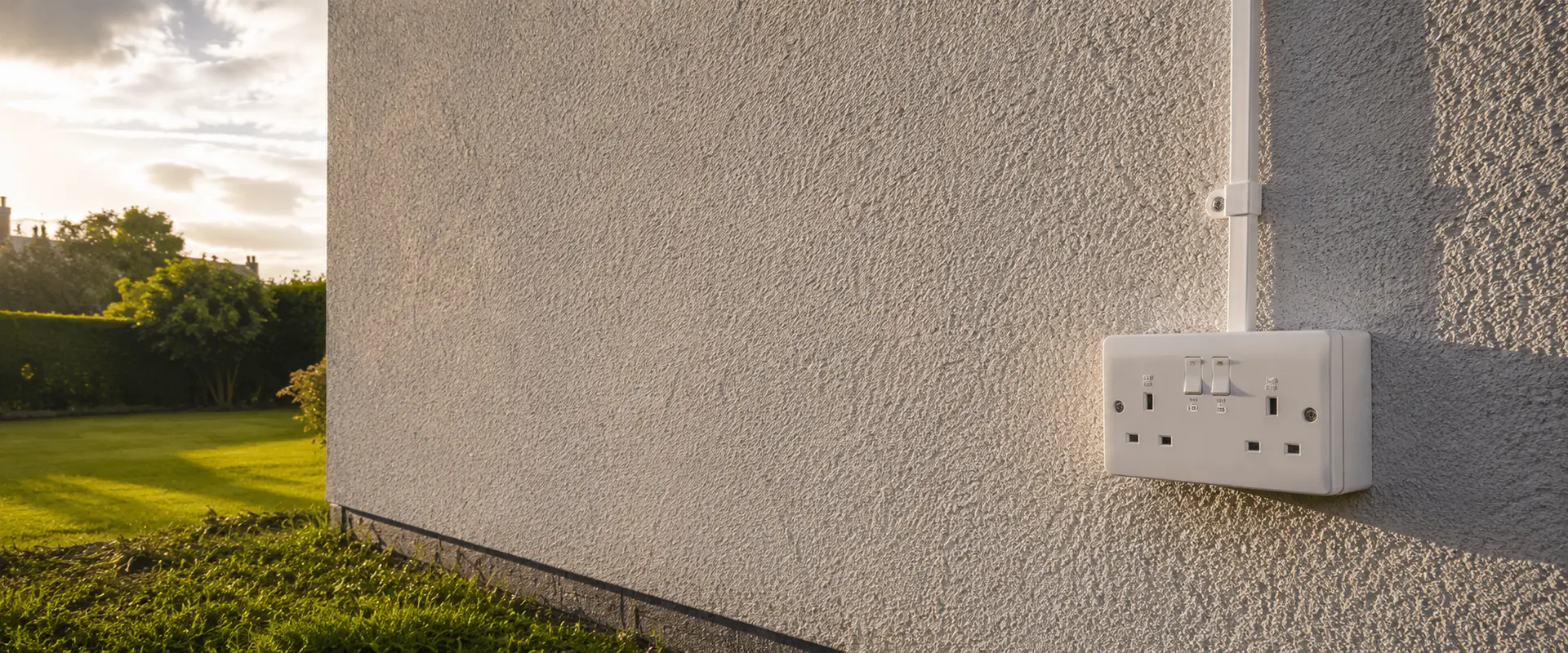
The most common request. A double IP65 socket mounted on an outside wall is suitable for garden tools, a lawnmower, outdoor speakers, or Christmas lights. The socket must be RCD protected and installed with a weatherproof cover that closes when the socket is not in use. Cost in Dublin: €150 to €400 depending on the cable run required.
- 2
Garden and landscape lighting
A dedicated lighting circuit runs from the consumer unit to a junction box in the garden, with spurs to individual fittings. Fittings must have IP ratings appropriate to their location: buried uplighters typically require IP67 or higher, post-top lights in beds require IP65 minimum. Low-voltage LED landscape systems are popular and efficient, but still require a mains transformer installed by a registered electrician. Cost: €300 to €800 for a standard scheme.
- 3
Shed and garage supply
A dedicated circuit from the house consumer unit via SWA underground cable or surface conduit. For a small garden shed used for light tasks, a 32A circuit with a single MCB is typically sufficient. A larger workshop or garage used for power tools or a vehicle lift may need a 63A supply and a sub-consumer unit in the outbuilding. Cost: €600 to €1,500 depending on distance and specification.
- 4
Security and flood lighting
PIR security lights and dusk-to-dawn floodlights are wired as a dedicated circuit or tapped off an existing lighting circuit, depending on load. LED floodlights draw little current and are often added to an existing circuit, but high-power security arrays or multiple heads may warrant a dedicated circuit. All fittings in exposed positions must carry an appropriate IP rating.
- 5
EV charger point
A home EV charger is a specialist outdoor installation requiring a dedicated 7kW or higher circuit, a suitable isolator, and in most cases a smart charger capable of integration with a home energy management system. SEAI grants are available for qualifying home chargers. EV charger installation is covered separately: see the related guide below.
Planning and Regulations for Outdoor Electrics
Adding outdoor electrical circuits to an existing dwelling is a straightforward process from a planning perspective in most cases. The electrical work itself does not require planning permission. What matters is whether the structure being connected, such as a shed or garage, is itself exempt from planning permission or has a valid grant of permission.
Under the Planning and Development Regulations 2001 (as amended), Class 3 of Schedule 2 permits the construction of certain garden structures without planning permission, subject to size and siting conditions. A garden shed or detached garage that meets the Class 3 exemption criteria can receive a permanent electrical supply without any additional planning steps. If the structure does not meet the exemption limits, a grant of planning permission is required before connecting a permanent electrical supply.
From an electrical regulatory perspective, all outdoor wiring is notifiable work under the CRU framework governing RECI-registered contractors. A registered contractor must carry out the installation and issue a completion certificate. Safe Electric, which administers the RECI scheme, publishes the register of authorised contractors online and homeowners can verify any contractor at safeelectric.ie before engaging them.
Outdoor Electrics: Common Questions
Find a RECI-Registered Electrician
Only a registered electrical contractor can carry out outdoor wiring and issue a valid completion certificate. Find a qualified electrician in your county today.
Find an electrician in your county