
RECI Registered Electricians: The List, How to Check It and Why It Matters
RECI stands for the Register of Electrical Contractors of Ireland. The RECI registered electricians list is the official record of contractors authorised to carry out notifiable electrical work in Ireland. The list is maintained under the Safe Electric scheme, which is operated by the Electrotechnical Council of Ireland (ECI) and overseen by the Commission for Regulation of Utilities (CRU). Any electrician who appears on the RECI registered electricians list has met a defined set of technical, insurance, and quality standards assessed against Irish law and Irish Wiring Rules (IS 10101).
The RECI Registered Electricians List: Who's on It and What It Means
For homeowners and property owners, RECI registration is the single most important thing to check before hiring an electrician for any significant electrical work. Only RECI-registered contractors can legally carry out notifiable works and issue the completion certificates that protect your home insurance, your mortgage, and your ability to sell your property.
What Does Being on the RECI Register Actually Mean?
To be listed on the RECI register, an electrical contractor must pass a technical assessment to IS 10101, the Irish Wiring Rules. This is not a one-off test: registered contractors are subject to periodic re-assessment and audit to confirm their work continues to meet the required standard. The assessment covers both the technical knowledge of the contractor and the quality of actual completed installations, which are inspected by Safe Electric assessors.
In addition to the technical standard, RECI-registered contractors are required to hold current public liability insurance. This protects you as a homeowner if something goes wrong as a result of work carried out on your property. An unregistered contractor may have no insurance at all, or inadequate cover that would not respond to a claim arising from electrical work. Asking to see proof of insurance is entirely reasonable, but verifying RECI registration on safeelectric.ie gives you the same assurance without needing to interpret a policy document yourself.
Registered contractors also operate under a quality assurance system accepted by Safe Electric, and they are subject to the Safe Electric complaints and disciplinary process. This means that if the work is substandard or a dispute arises, you have a formal avenue for complaint that carries real consequences for the contractor. The complaints process is administered through safeelectric.ie and is separate from any civil or legal remedy you might also pursue. For an unregistered contractor, no equivalent process exists.

Four Things Every RECI-Registered Contractor Must Have
Technical assessment pass
A demonstrated pass of the IS 10101 Irish Wiring Rules standard, verified by Safe Electric through assessment and ongoing inspection of completed work.
Public liability insurance
Current public liability insurance must be maintained throughout registration. This provides financial protection for homeowners if property damage or injury results from the work.
Quality assurance system
Contractors must operate a Safe Electric-accepted quality assurance system covering how they manage, document, and certify their work. This ensures consistent standards across all jobs.
Completion certificate authority
Only RECI contractors can issue legally valid Notifications of Completion of Work for notifiable electrical work. This is the certificate your insurer, lender, and solicitor will require.
Complaint and disciplinary process
Registered contractors are subject to the Safe Electric complaints process. If work is substandard, you can make a formal complaint that carries real regulatory consequences for the contractor.
Unique RECI number
Every registered contractor has a unique RECI number that can be looked up on safeelectric.ie. The number appears on their Safe Electric ID card and on every completion certificate they issue.
How to Verify a Contractor Is RECI-Registered
Checking RECI registration takes less than a minute. There are two methods, and ideally you should use both before committing to any electrical contractor for notifiable work.
Search safeelectric.ie
Visit safeelectric.ie and use the contractor search tool. You can search by name, by county, or by RECI registration number. The search returns a live result from the current register. Any contractor who appears is registered and in good standing at that moment. A contractor who does not appear is not currently registered, regardless of what they tell you.
Ask for the Safe Electric ID card
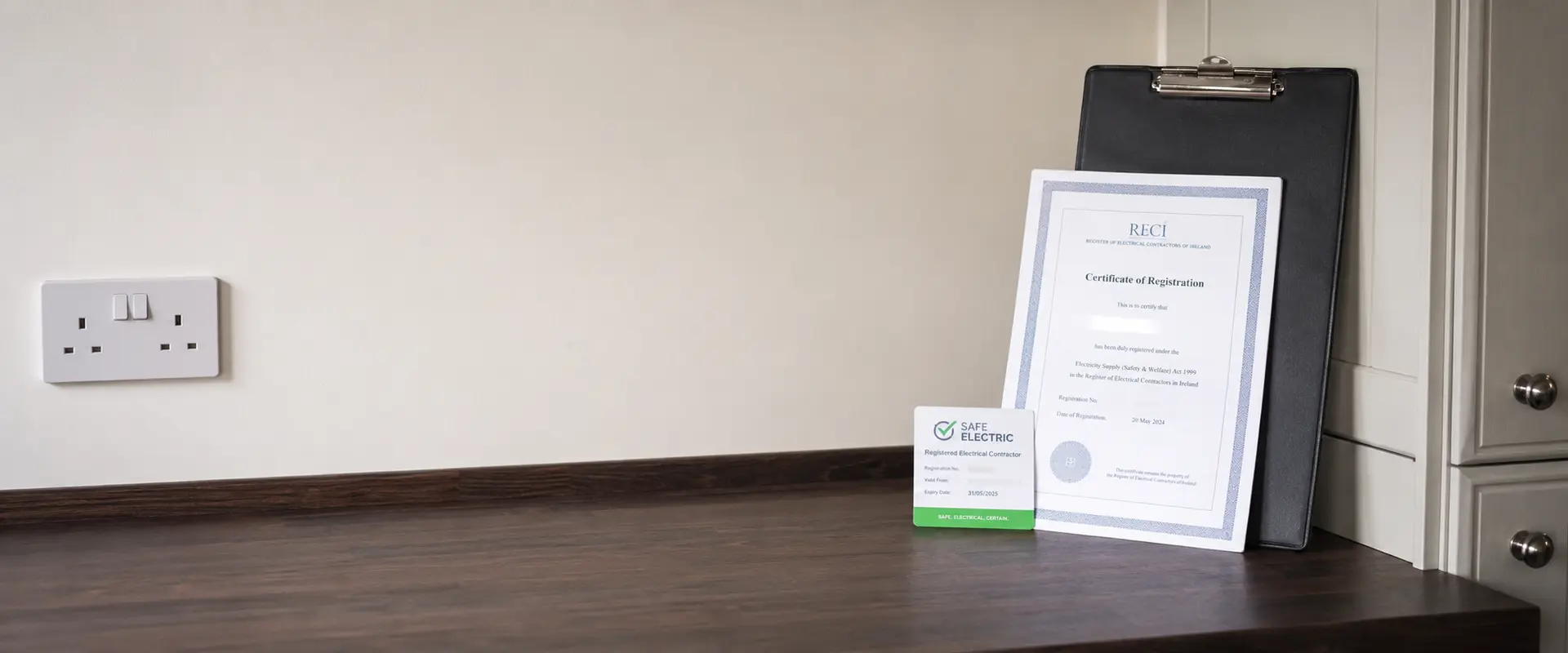
Every RECI-registered contractor carries a Safe Electric ID card, which displays their name, their unique RECI registration number, and the expiry date of their current registration. Ask to see this before any work starts. Cross-reference the RECI number on the card against the safeelectric.ie search result to confirm both match. A genuine registered contractor will expect this question and will have no objection to showing their card.
Use electriciansinireland.ie
The electrician search on this site only returns RECI-registered contractors. If you find and hire an electrician through electriciansinireland.ie, their RECI registration has already been verified. You can then cross-check their specific RECI number on safeelectric.ie for additional reassurance before work begins.
What Happens If You Use an Unregistered Electrician?
The consequences of using an unregistered contractor for notifiable work are practical and financial, not just regulatory. They tend to surface at the worst possible times: when selling a property, making an insurance claim, applying for an SEAI grant, or re-mortgaging. An unregistered contractor cannot issue a valid completion certificate. Without a valid certificate, the work is legally uncertified.
Home insurance is the most immediate risk. Irish home insurance policies typically require that electrical work meets statutory requirements. If a fire or electrical incident is traced to uncertified notifiable work, your insurer has grounds to deny the claim. You may not discover this exclusion until you actually need the policy. Insurers take the position that uncertified notifiable work represents an undisclosed material change to the risk they agreed to cover.
Property transactions create another flashpoint. When selling a house in Ireland, your solicitor is required to provide a set of title documents to the buyer's solicitor. Completion certificates for any notifiable work carried out during the period of your ownership form part of that documentation. A buyer's solicitor will raise a specific requisition on title requesting these certificates. If they are missing, the sale can be delayed or blocked entirely until the position is resolved. In practice, resolution requires a retrospective Electrical Installation Condition Report (ECIR) from a RECI contractor, which may identify work that does not comply with IS 10101 and must be remediated before any certificate can be issued. The cost of retrospective certification and remediation regularly exceeds the saving made by using an unregistered contractor in the first place.
SEAI grants are also affected. The Better Energy Homes scheme, the One Stop Shop retrofit programme, and the SEAI EV charger grant all require a valid RECI completion certificate as a condition of payment. If you commission an EV charger or heat pump installation from an unregistered contractor, you will not be able to claim the relevant SEAI grant, regardless of the quality of the installation itself. Lenders take a similar position when re-mortgaging: if notifiable work has been carried out without certification, a new lender may decline to proceed until the installation has been retrospectively assessed and certified.
RECI Registration: Frequently Asked Questions
Is a RECI number the same as a Safe Electric number?
Yes. The RECI number and the Safe Electric registration number refer to the same identifier. RECI is the name of the register, and Safe Electric is the name of the scheme that administers it. When a contractor gives you their Safe Electric ID card or you find them on safeelectric.ie, the number shown is their unique RECI registration number. It appears on every completion certificate they issue and can be used to verify their status at any time through the safeelectric.ie search tool.
Can registration lapse? How do I know if it is current?
Yes, registration is not permanent and must be renewed. A contractor’s registration can lapse if they fail to renew, fail a re-assessment, or are suspended or removed following a disciplinary process. This is why checking safeelectric.ie immediately before hiring is important, rather than relying on a recommendation from several years ago. The Safe Electric ID card also shows the expiry date of the current registration period, which you should check is valid on the date work is being carried out.
What if a contractor says they are registered but does not appear on safeelectric.ie?
The safeelectric.ie register is the authoritative source. If a contractor tells you they are RECI-registered but cannot be found on the register, treat this as a serious concern. Common explanations include a lapsed registration, a suspension following complaints, or simple dishonesty. Ask the contractor to explain the discrepancy and to show you their Safe Electric ID card. If you cannot reconcile the claim with the register result, do not proceed with that contractor for any notifiable work.
Do I need to keep the completion certificate after the work is done?
Yes, and it is important to store it safely for as long as you own the property. The completion certificate is the document that demonstrates the work was carried out by a RECI-registered contractor to IS 10101 standard. You will need it if you make an insurance claim relating to the affected installation, if you re-mortgage, and when you eventually sell the property. Solicitors acting on a sale will request completion certificates for any notifiable works carried out during your ownership. If a certificate is lost, recovering it requires contacting the original contractor, who may or may not have retained a copy.
How do I make a complaint about a RECI-registered contractor?
Complaints about RECI-registered contractors are handled by Safe Electric through the formal complaints process at safeelectric.ie. To make a complaint, you will need the contractor’s RECI number, the address where the work was carried out, and a description of the issue. Safe Electric can investigate and take disciplinary action, including suspension or removal from the register. This formal process is one of the key advantages of using a registered contractor over an unregistered one: you have a named regulatory body to complain to, and the complaint carries real consequences for the contractor’s ability to trade.
Keep Reading
All guides →Find a RECI-Registered Electrician Near You
Every electrician listed on electriciansinireland.ie is RECI-registered, authorised to carry out notifiable works, and able to issue you a valid completion certificate.
Find an electrician near you